






The fundamentals of cymbal materials
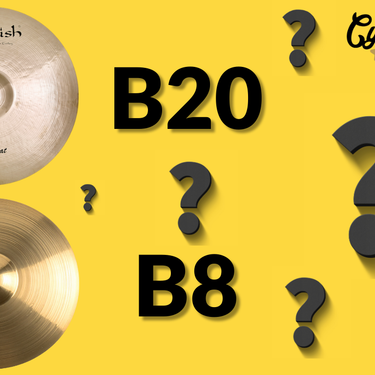
In the world of drum set cymbals, the material used largely defines the sound character. The two most prominent bronze alloys—B8 and B20—differ fundamentally in composition and, in turn, in their acoustic behavior. While B8 cymbals use an alloy of 92% copper and 8% tin, B20 cymbals are made from 80% copper and 20% tin.
This seemingly small difference in tin content produces dramatic changes in sound. The higher tin content of the B20 alloy lends cymbals a more complex harmonic structure and a more pronounced capacity for resonance.
Metallurgical properties compared
The metallurgical characteristics of both alloys manifest in different physical properties. B8 bronze is noted for its higher hardness and durability, whereas B20 bronze is softer and more malleable. These differences influence both manufacturing options and the final sonic development of the cymbals.
"The material is the soul of a cymbal—it determines not only the core voice, but also how overtones evolve and how the instrument responds to different playing techniques."
Sound characteristics of B8 cymbals
B8 cymbals produce a characteristically brilliant, cutting sound. The alloy favors a fast response with a pronounced attack. The reduced tin content leads to a simplified overtone structure, yielding a more direct, focused sound.
These traits make B8 cymbals a natural fit for styles that demand clarity and cut. Rock and metal drummers value the aggressive core character and the ability to hold their place in dense band mixes.
Frequency spectrum and sustain behavior
The frequency spectrum of B8 cymbals centers primarily on the mid and upper ranges. Sustain characteristics show a controlled decay with limited complexity. These qualities enable precise rhythmic accents without excessive harmonic interference.
- Fast attack phase
- Reduced overtone complexity
- Controlled sustain
- Pronounced midrange frequencies
The sound character of B20 cymbals
B20 cymbals reveal a completely different sonic dimension. The higher tin content enables rich overtone development with nuanced harmonic layering. These cymbals respond sensitively to different striking techniques and unfold complex soundscapes.
The softer alloy encourages organic vibration with extended sustain phases. Jazz and fusion drummers prefer this musical flexibility and the ability to shape subtle dynamic nuances.
Harmonic complexity and resonance behavior
The harmonic architecture of B20 cymbals is defined by its depth and variety. Multiple overtone series develop simultaneously to create a dense acoustic fabric. Resonance unfolds progressively, with different frequency components emerging at different moments.
This dynamic sonic evolution enables expressive techniques such as crescendo rolls or subtle brushwork. The cymbals are highly responsive to playing intensity and striking position.
Processing and manufacturing differences
Working with both alloys requires specific craftsmanship. B8 bronze can be shaped more precisely thanks to its hardness, whereas B20 bronze needs more delicate handling. Traditional hammering impacts the final sound of each alloy in distinct ways.
Istanbul-based cymbalsmiths have developed techniques over centuries to unlock the full potential of both alloys. Temperature control during the forging process significantly affects the crystal structure and thus the acoustic properties.
| Property | B8 cymbals | B20 cymbals |
|---|---|---|
| Tin content | 8% | 20% |
| Hardness | High | Medium |
| Overtone complexity | Low | High |
| Sustain length | Short-Medium | Long |
Traditional forging techniques
Traditional forging techniques vary by alloy. B20 bronze requires controlled heat treatment and gradual forming. Its more malleable properties allow for more complex hammer patterns that contribute to the characteristic overtone richness.
Applications and musical contexts
The choice between B8 and B20 cymbals depends primarily on the musical context. Rock and metal productions benefit from the directness of the B8 alloy, while jazz, fusion, and world music applications call for the nuance of B20 cymbals.
Which factors should you consider when choosing cymbals? The band setup, recording context, and your personal playing style determine the optimal material. B20 cymbals reveal their full complexity in acoustic settings, while B8 cymbals play to their strengths in amplified environments.
Style-specific applications
Jazz drummers value the responsive nature of B20 cymbals for brush work and dynamic modulation. Their harmonic richness supports improvisation and allows subtle tonal differentiation.
Rock drummers, on the other hand, lean on the cut of B8 cymbals for powerful accents and rhythmic precision. Controlled overtone development prevents masking in dense arrangements.
How does room acoustics influence material choice? Large concert halls favor the resonance of B20 cymbals, while compact clubs often call for the control of B8 alloys.